
A reflection for the 6th Sunday in Easter, Year C. The readings are Acts 15:1-2, 22-29; Revelation 21:10-14; 22-23 and John 14:23-29.
Whoever loves me will keep my word and my Father will love them and we will come to them and make our home with them… Let me get this straight: If you love me; you will keep my word. That’s a no-brainer! If you love someone you care about what they think, what they say and what they want. If you love them, you do what they ask you to do. And for Christians, who love Jesus, we want to keep his word.
Two weeks ago we heard about the Good Shepherd who told us that His sheep know and listen to His voice. But Jesus’ voice is but one voice among many: the voice of pleasure and the voice of power; the voices of pride and despair, of fear and doubt. How do we know the voice of Christ? We listen. That’s it. We have to make quiet time for listening so we can tune in to the voice of Jesus. If our prayer time is consumed with speaking: thanksgiving prayers and petition prayers and asking for forgiveness and offering praise – all the while listening to praise and worship music – then it’s a bit one-sided. We have to be quiet – silent – so we can listen. We need to start this today. Set aside quiet time each day. Be silent and listen.
When you do, how do you know you’re listening to the voice of Jesus so that you can keep his word? How do we discern His voice among all the voices in the world? And how do we recognize his voice when it’s about something that Jesus didn’t speak about? It’s easy to keep His word when it’s about something that Jesus spoke about, but how do we keep His word about stuff that Jesus never spoke about?
Read more…

A reflection for the 5th Sunday in Lent, Year C. The readings are Isaiah 43:16-21; Psalm 126; Philippians 3:8-14 and John 8:1-11.
Oscar Wilde once said that the only difference between a saint and a sinner is that saints have a past and sinners have a future. That, I think is the good news for today.
In the first reading we have the Jewish people in exile, longing for freedom. They longed for the new Jerusalem, the new Exodus, the new Moses, the new Passover, the new Manna; the new Heavens and the new earth. And God tells them through the prophet Isaiah to not remember the things of the past; that He indeed is doing something new. This is our God: The God who makes all things new. That’s why the Psalm says that we are filled with joy: Because the Lord has done great things for us!
Read more…
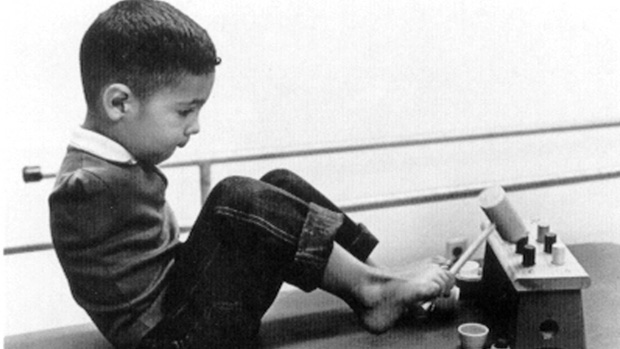
A young Tony Melendez playing.
A reflection for the 5th Sunday, Ordinary Time, Year C. The readings are Isaiah 6:1-2; 3-8; Psalm: 138; 1 Corinthians 15:1-11 and Luke 5:1-11.
All this talk about the Zika Virus causing children to be born with a deformed heads has made me think of a whole lot of other children who were born with deformities in the late 50s, early 60s. At the time, pregnant women were given a drug, Thalidomide to help them with their morning sickness. As a result, thousands of babies were born with severe deformities. One of these children was born in Nicaragua. His name is Tony Melendez. Tony was born without arms but he never really saw himself as disabled or even different. Everything you can do with your hands and arms, he is able to do. He can draw, he can write, he drives – he can throw a Frisbee… he can probably even do some things you and I can’t do. At some point, while growing up, Tony figured that he could learn to play guitar and he did. He’s actually pretty good.
In 1987 Tony was singing and playing guitar with his Church group and that year Pope John Paul II was in Los Angeles and Tony was invited to play. He sang a song called Never Be the Same. After that moment, I don’t think Tony’s life was ever the same. When he was done, Pope John Paul got up and jumped down from the stage (to the dismay of his security, I’m sure), walked over to the platform where Tony was sitting and kissed him. (You can watch the video here below.) The look on Tony’s face is one of humility; he’s moved, a bit embarrassed, perhaps. The Pope then says, “Tony, Tony… you are truly a courageous young man. You are giving hope to all of us. My wish to you is to continue giving this hope to all the people.” That night, Tony Melendez had a powerful and moving encounter with the divine – that was an encounter with God and it led to a call. It changed his life and to this day, Tony Melendez continues giving hope to all the people.
This is what always happens after we have a meaningful encounter with God; it leads to a call. Today we have three readings and three call stories, Isaiah’s, Paul’s and Simon Peter’s – they are very different; different people, different locations, different circumstances, but all very similar. In fact, very similar to Tony’s.
 A reflection for the 4th Sunday, Ordinary Time, Year C. The readings are Jeremiah 1:4-5; 17-19; Psalm 70; 1 Corinthians 12:31-13:13 and Luke 4:21-30.
Check these out:
The president of the Michigan Savings Bank advising Henry Ford’s lawyer not to invest in the Ford Motor Co., 1903: “The horse is here to stay but the automobile is only a novelty – a fad.”
The New York Times published in 1936: “A rocket will never be able to leave the Earth’s atmosphere.”
Thomas Watson, chairman of IBM said in 1943: “I think there is a world market for maybe five computers.”
A Record label executive said in 1962: “Four-piece groups with guitars particularly, are finished. The Beatles have no future in show business.”
Ken Olson, president and founder of Digital Equipment Corp. said in 1977: “There is no reason anyone would want a computer in their home.”
An anonymous publishing executive wrote to J.K Rowling in 1996 saying that: “Children just aren’t interested in witches and wizards anymore.”
And Microsoft CEO Steve Ballmer, 2007: “There’s no chance that the iPhone is going to get any significant market share. No chance.”
Funny, eh?
Read more…


 deacon pedro