
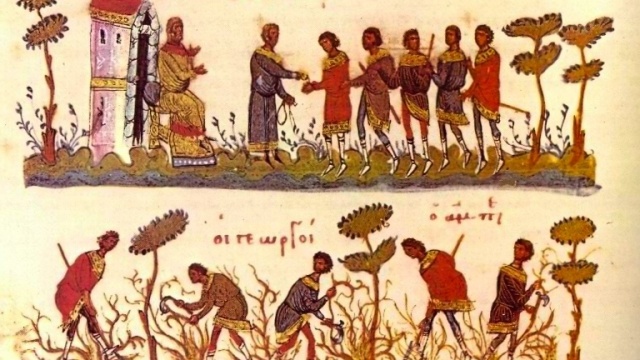
A reflection for the 25th Sunday in Ordinary Time, year A, The readings are Isaiah 55:6-9; Psalm 145 Philippians 1:20, 24, 27a and Matthew 20:1-16a
It’s not fair! Every time I hear that parable, the 6-year-old inside of me wants to scream, “no fair!” How is that fair? The guys who showed up at 5pm and worked for an hour, get paid the same as the guys who were there at 8 in the morning. It’s not right. And it makes me angry because we’ve all been there: You’re the most experienced and senior person at work and when there’s a new project (the project you’ve been looking forward to) or there’s a new big account, who gets it? The youngest, most inexperienced person at your work. Or you’re the best basketball player on your team and when the university scouts come, who gets the scholarship? Not the best player, but the tallest player.
It’s not fair. And especially as Christians. Christianity is the champion of human rights and social justice. We wouldn’t even have a concept of human rights or social justice; we wouldn’t have civil rights and even labour unions if it wasn’t for Christianity. So I don’t get this parable. The last shall be first and the first shall be last? I don’t get it. I guess that’s why God says through Isaiah in the first reading that his ways are not our ways. Not only are his ways not our ways, but his ways are better than ours: As high as the sky is above the earth, so high are God’s ways above our ways. There’s so much about God’s ways that we cannot comprehend. Today’s parable is one of them.
Read more…
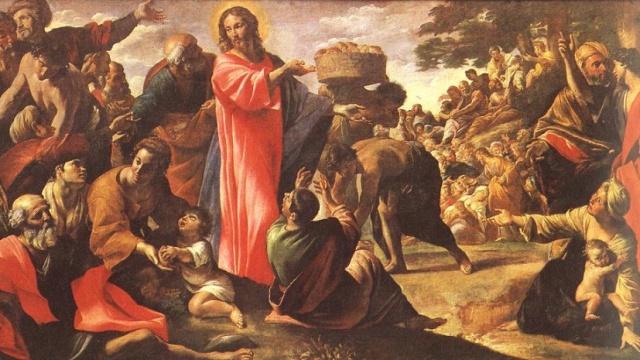
Homily for the 18th Sunday, Ordinary Time, Year A. The readings are Isaiah 55:1-3, Psalm 145, Romans 8:35, 37-39 and Matthew 14:13:21.
I didn’t have a great week: It was busy (that’s why this is not getting posted until Monday): A little too much to do at work; a funeral on Tuesday – a parishioner; those are always hard – and Saturday I was supposed to give a talk to a group in Caledon. I drove for 45 minutes and when I arrived there was no one there: I had the wrong date! Suffice it to say that I’m glad it’s a long weekend. But I wonder what the week was like for other people. How was the week for people stuck on the Burlington Skyway bridge on Thursday? Or how was the week for people who were planning on traveling to Ottawa or Montreal on the train? How was the week for those Malaysian and Dutch airline investigators who are trying to get to the crash site in Ukraine? Or how was the week for all the aid workers in Liberia, Guinea, Sierra Leone and Ivory Coast who are working with Ebola virus patients? How was the week for those Ebola patients and their families? How was the week for people living in Baghdad? How was it for people living in Gaza? I wonder what the week was like for the family of Jaime Palm, the 15-year old girl who died in that strange accident on the soccer field in Bradford. My week was not great, but it was not bad. There’s always someone in the world who is having a bad week.
This Sunday’s Gospel story is the only story that is found in all four Gospels. This week we heard Matthew’s version, but it’s also found in Mark, Luke and John. It’s a story that we’ve heard so often – we know it so well – Jesus feeds the 5000; the multiplication of the 5 loaves and 2 fish (and half the time we say 5 fish and 2 loaves!) that we don’t really pay attention to it and we miss some other parts of the story. Today’s reading begins with Jesus not having a good week. He’s just found out that his cousin John the Baptist, who was in prison, has been beheaded by King Herod and so He goes off to a deserted place by himself. That’s what I want to do when I am having a bad day or I am feeling sad or have received bad news; I want to go off by myself – to pray, but also to be alone. I imagine that Jesus was feeling a bit sad, but also a bit angry and maybe even a bit afraid because He knows that what happened to John will likely also happen to Him. And then the crowd show up. I don’t know about you, but when I am in a crappy mood, I want to be alone. I don’t want people around and the last thing I want to do is talk to people, listen to people or listen to their problems. But Jesus goes to be with them. He spends time with them and he cures them.
Read more…

A reflection for the 17th Sunday in Ordinary Time. The readings are Kings 3:5, 7-12; Psalm 119; Romans 8:28-30 and Matthew 13:44-52.
Can you imagine God appearing to you in a dream and telling you to ask for anything – that He would give you anything you want? What would you ask for?
I think I would be the first to ask for enough money to make sure I can pay my mortgage – and enough money to pay for my kids’ university. And if I had a lot of money I could donate it to charity or do something great for the Church. Maybe I’d ask to have someone cured of an illness, or that I wouldn’t be so selfish. And after thinking about what I want, with a tinge of guilt I’d ask for peace between Israel and Hamas; and peace for Christians in Iraq – peace in Ukraine and peace in Venezuela… Isn’t it true that we’d probably tend to think about what we want for ourselves first? And it’s not wrong. It’s not a bad thing for me to pay my mortgage or to put my kids through university. It’s not like I’m asking to be a rock star or to take over the world. I’d like to have a super power, like fire bending… What would you ask for?
I recently heard a talk at a Conference by Fr. Jim Sullivan, OP who told us a story about St. John of the Cross, who was a Carmelite priest and a mystic. Jesus spoke to him and said, “you’ve done well; what would you like as a reward?” And – we shouldn’t respond what St. John responded – St. John of the Cross said, “to suffer and to be despised because of you.” We shouldn’t answer what St. John of the Cross answered; we have to be careful what we ask for, ‘cause we might get it.
Read more…
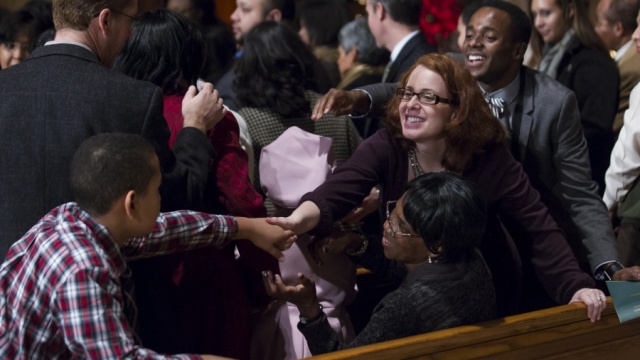
A reflection for the Solemnity of Pentecost. The readings are Acts 2:1-11; Psalm 103; Corinthians 12:3b-7, 12-13 and John 20: 19-23.
Today we celebrate the coming of the Holy Spirit and in the readings we have two completely different versions of the same event. In the book of Acts, Luke describes the event that we all know with the hurricane-like winds, the tongues of fire and the disciples speaking in tongues. John’s version is a bit different, but for me, much more compelling.
Let me describe the scene for you: The apostles are terrified. They feel confused, disheartened, abandoned, let down… everything that they were working towards has been a failure; all their hopes are shattered. That man whom they followed, who they thought was the Son of God, the Messiah, the one who was going to liberate Israel from Roman occupation was arrested, tortured and killed. And who’s next? Who are they coming for next? Who will they kill next? This man’s disciples, probably. So the apostles are behind locked doors, hiding, full of fear… and, who appears in the midst of them? Jesus. And what does He tell them? “Peace.” Jesus gives them peace: “Have peace.” “Do not be afraid.”


 deacon pedro