

My homily for the 32nd week in Ordinary time, year C. The readings are Maccabees 7.1-2, 7, 9-14
Psalm 17; 2 Thessalonians 2:16-3:5 and Luke 20:27-38.
God is God, not of the dead, but of the living. Might seem obvious to us Christians today, but this was a notion that was fairly new to most people in the time of Jesus. Especially the Sadducees, because the Sadducees did not believe in the resurrection. The Sadducees were so sad, you see ; ) [OK, that was a joke…]
The Sadducees did not believe in the resurrection or in eternal life because they claimed that there was no mention of resurrection or eternal life in the Hebrew Scriptures, which were the Books of Moses, the Torah (also known in Greek as the Pentateuch). These are the first five books of the Bible: Genesis, Exodus, Leviticus, Numbers and Deuteronomy. So when they approach Jesus today, they are not really interested in learning about heaven or about marriage; they simply want to ridicule Jesus and his belief in the resurrection; because Jesus was well known to be preaching eternal life: He talked about the Kingdom of Heaven all the time! So they come up with this ridiculous scenario to make fun of Jesus, to show how illogical the idea of resurrection was. So Jesus answers them, not just telling them that there is eternal life, but also what life in heaven will be like: We will be like angels and there will be no marriage; and we will not die again so we won’t have to worry about our descendants, which was very important for Jewish people; that’s how they lived on: Through their descendants. This is what this whole tradition of having a widow marry her dead husband’s brother: So they wouldn’t be left without descendants. But in heaven you won’t have to worry about descendants because you won’t die and you won’t have to live on through your descendants because you will live forever! And then Jesus gives them proof from one of the Books of Moses, from the Torah. But he doesn’t pick just any part – He picks one of the most important part – a part that every Jew knew very well – when God appears to Moses in the burning bush, from the Book of Exodus (see Exodus 3). God appears to Moses and says to him to go back to Egypt and tell Pharaoh to “let my people go.” Moses asks, “Who should I say sent me?” and God says, “Tell him I AM sent you.” I AM the God of Abraham, the God of Isaac and the God of Jacob.” (Exodus 3: 6) And so, Jesus explains, if God who IS, says He is the God of Abraham, Isaac and Jacob, then they can’t be dead because God is not the God of the dead but of the living.
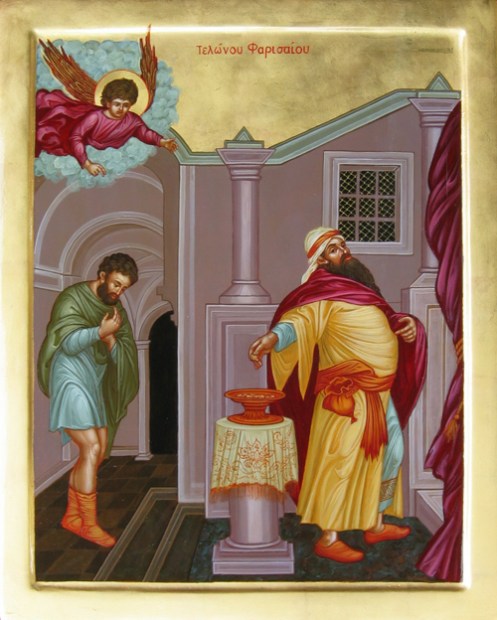
A reflection for the 30th Sunday in Ordinary time, year C. The readings are Sirach 35:15-17, 20-22; Psalm 34 ; 2 Timothy 4:6-8, 16-18 and Luke 18:9-14.
“Lord, Jesus Christ, Son of God, have mercy on me a sinner.” That’s the Jesus Prayer, perhaps you know it: “Lord, Jesus Christ, Son of God, have mercy on me a sinful one.” I don’t like that prayer. I don’t. I don’t like to think of myself as a sinner: a sinful one. Who does?
I was just reading the little introduction to today’s readings in the Living With Christ missal, written by Bernadette Gasslein, and she says that when the new translation of the Mass was coming out, one of the parts people objected to the most was “through my fault, through my fault, through my most grievous fault.” It’s true, eh? Now most of us who are used to the Mass in other languages were already used to “mea culpa, mea culpa, mea maxima culpa”, but those who only knew the Mass in English were not happy about that one. Because who wants to think of themselves as a sinner? That’s why people don’t go to Confession. And then, after “my most grievous fault” what do we do? “Lord, have mercy on me.” I don’t like that. “Have mercy!” It makes me think of an evil king that’s going to take my head off for no reason – like the Queen of Hearts in Alice in Wonderland, “off with her head!” – and I have to beg for my life: “have mercy on me, please!” I don’t like that because I don’t think God is an evil king that’s going to take my head off for no reason. And I don’t think I have to beg for my life.
Read more…
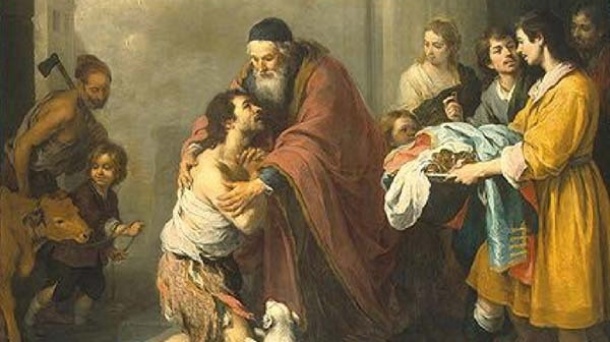
My homily for the 24th Sunday, year C. The readings are Exodus 32:7-11, 13-14, Psalm: 51 (I will get up and go to my Father); 1 Timothy 1:12-17 and Luke 15:1-32
Let’s review: If it was up to God, everyone would be saved. But it’s not entirely up to God. Jesus Christ opens the door; we have to go through the door; He’s not going to reach out and grab you and pull you through. Although sometimes He comes pretty close. ‘Cause that’s what you do when you love something and you lose it.
I don’t really get the whole sheep thing. Seriously, if I had 100 sheep and I lost one, I’m not going to leave the other 99 to go find this one sheep. It’s not worth the risk of losing other sheep – unless that one sheep is really valuable. Have you ever lost a pet? Our dog Max has gotten out of our yard a few times and when it happens, we stop everything – everyone goes out – we go searching until you find the dog. What if it wasn’t a pet, but your child? I was once a camp counselor and we took the kids to Canada’s Wonderland. One of the kids was 6 years old and he was in my group and I lost him. I have never been so worried, so afraid, so desperate. Thankfully we found him, he was fine – he was lost for about 20 minutes. Those were the longest 20 minutes of my life. And it wasn’t even my kid. What if it had been my own child? I don’t wish that on anyone. And that’s how God searches for us. There’s a beautiful 19th century poem by Francis Thompson called the Hound of Heaven that says that God hunts us like a blood hound. We run away, but he chases us like a hound dog. He searches until He finds us. Like a lover seeks his beloved. Like a woman who loses one of her 10 precious silver coins. Yes. Sometimes Jesus opens the door and reaches in to grab us and pull us through.
Read more…

September 14 is the Feast of the Triumph or Exaltation of the Cross. For the last two days we’ve been looking at why we exalt the cross, an instrument of death. We saw that Jesus died to destroy death for ever, so we don’t have to be under the power of death anymore. Sin leads to death. And because disobedience to God is sin, it also leads to death. It was Adam and Eve’s disobedience that led to death.
Now listen to something St. Paul says in his letter to the Philippians, which was the second reading yesterday: “He humbled himself and became obedient to the point of death – even death on a cross.” (Phil 2:8). It was because of Adam’s disobedience that sin entered into the world. St. Paul also says that, in the same way that Adam’s disobedience made us sinners, Jesus’ obedience makes us righteous (Rom 5:19).
Read more…


 deacon pedro