
First published May 13, 2011
A few weeks ago I was looking for stats on Canadians’ views on abortion. It’s such a hard topic because pretty much everyone can find the right poll to suit their position on the matter. For example, there the 2008 Angus Reid poll that shows that half of Canadians want abortion to remain legal. How do you reconcile that finding with the 2007 Environics Poll that shows that a third of Canadians support the view that human life should be protected from conception. I guess it’s all about the questions you ask.
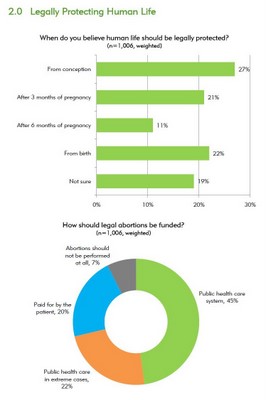 I was pleased to know that yesterday, Abacus Data released the results of a poll conducted on behalf of Sun News. They surveyed just over 1000 Canadians over the age of 18 and they asked exactly the questions that I would have asked. Let me highlight some key findings.
When asked “When do you believe human life should be legally protected?” the results were:
- 59% responded that human life should be legally protected in some way before birth
- 27% responded that human life should be protected from the moment of conception
- 32% responded that human life should be protected during pregnancy and
- 22% responded that it should be protected after birth
When asked about their position on abortion:
- 52% said they support the right of a woman to make choices about their body
- 17% support abortion in only extreme circumstances
- 18% are opposed to abortion but recognize the right of individuals to make their own choices, and
- 8% believe abortion should be illegal.
Another issue that is gaining interest among Canadians is that of funding. Perhaps many of you are not aware that in Canada almost all abortions are paid for by taxpayers. In most provinces, all abortions are paid for under the publicly funded system. In New Brunswick, hospital abortions are paid for by taxpayers but private clinic abortions are not, and in Prince Edward Island, abortions are not performed in hospitals or private clinics. However, PEI does cover abortions performed elsewhere if they have been declared by a doctor to be medically necessary and have been pre-authorized and approved. Based on the statistic that there are just over 100,000 abortions in Canada every year, and that an abortion costs $800 on average, this is costing taxpayers $80 million a year. That’s $80 million that are not going to fund other healthcare programs. But I digress…
Back to the survey. On the issue of funding:
- 45% of respondents thought that abortions should be entirely funded by public health care, and
- 42% believe the procedure should be paid for by the patient or by the public system in only extreme circumstances.
Lastly, a comment that I always get is that “Canadians don’t want the debate re-opened” or “the issue has been settled.” As far as I am concerned, since there is no abortion law in this country, the issue has not been settled. In response to a question about public debate on the topic of abortion 52% of Canadians said they are not afraid of a public debate about abortion while 26% believe it is an issue that should be left alone.
I guess I am among that 52% that is not afraid to have a public debate.
Here is the full Abacus Data Report.
And these were the survey questions:
Abortion is a controversial issue and there are many different positions and beliefs about it.
1. When do you believe human life should be legally protected?
- From conception
- After three months of pregnancy (first trimester)
- After six months of pregnancy (second trimester)
- From the point of birth
- Not sure
2. Which of the following statements, if any, best represents your view on abortion? [rotate statements]
- I support the right of women to make choices about their own bodies
- I support legal abortion, but only in extreme circumstances
- I am personally opposed to abortion, but recognize the right of individuals to make their own choices
- I am personally opposed to abortion and feel that it should be illegal in Canada
- None of these
- Unsure
3. How should legal abortions continue to be funded:
- Covered by the public health care system
- Only covered by the public health care system in extreme cases
- Paid for by the patient
- Abortions should not be performed under any circumstances
4. Which of the following statements, if either, comes closest to your view about the abortion debate in Canada? [rotate statements]
- Some things are better left alone. Now is not the time to reopen the abortion debate.
- When discussing matters of life and death there is never a bad time for debate. We shouldn’t be afraid to debate tough issues in public.
- Neither
First published March 19, 2011
When Joseph awoke he did as the angel of the Lord had directed him…
Those are the words that stand out for me from today’s Gospel (Matthew 1:16, 18-21, 24) on the Solemnity of St. Joseph, Husband of Mary.
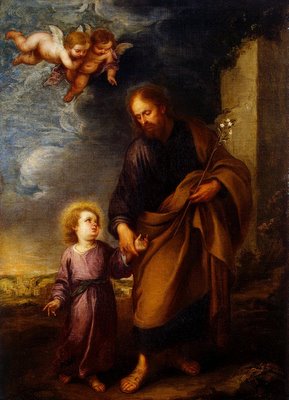 We don’t know a lot about Joseph – we know that his Father’s name was Jacob and that he was the husband of Mary. We know that he was a carpenter and that he lived in Nazareth. We know that before he and Mary lived together, after their engagement, he found out that she was pregnant and instead of shaming her or causing scandal, he decided to divorce her quietly. The Gospel tells us that he did this because he was an upright man, a man of principle.
We also know that he was a righteous man who followed the law: He observed religious law – we know he went to Jerusalem for the Jewish festivals. He also followed civil law: He went to Bethlehem for the census. We also know that Joseph had dreams. God spoke to him in his dreams and he followed his dreams.
What’s also interesting to me is that nowhere in the Gospels do we ever hear anything Joseph says. He never says anything. But he’s a man of action: he does what the angel tells him; he takes Mary as his wife; he goes to Bethlehem; he finds a place to stay for the night; he takes his family to Egypt… He’s a man of action – not a man of words.
For centuries, scholars and artists have tried to figure out Joseph’s words. One of my favourite Christmas songs is by Michael Card, Joseph’s song:
How can it be, this baby in my arms, sleeping now, so peacefully. The son of God, the angel said, how could it be? O Lord I know he’s not my own, not of my flesh, not of my bone. Still Father let this baby be the son of my love.
Then Joseph prays:
Father show me where I fit into this plan of yours. How can a man be father to the son of God? Lord, for all my life I’ve been a simple carpenter… how can I raise a king? How can I raise a king?
I like this song because to me it shows what Joseph models perfectly: He was a man after God’s will. He longed to know God’s will and searched to see how he fit into the Father’s plan.
And just like God had a plan for Joseph, God has a plan for each one of us. The plan does not need to be more than that He wants us to be upright and righteous. He wants us to be loving parents, loving husbands and wives. God wants us to follow the law – observe the commandments. But, just like Joseph, we may feel that we don’t have anything to contribute: that we are nothing but simple carpenters…we may feel insignificant, that we have nothing to offer. Still, God has a plan for us. God gives us dreams and speaks to us in our dreams.
But also, just like Joseph we may never see the fruit of our labour. We may never reap the harvest. The first reading for today’s Solemnity, from the book of Samuel tells us about a promise to King David – we hear about it in Responsorial Psalm 89 as well: The son of David will live forever or his line will continue forever. But David never lived to see this promised fulfilled. In the second reading, from Romans Chapter four, Paul is telling the Romans about another upright man who never saw the fruit of his work: Abraham. He did God’s will, but never saw the fulfillment of God’s promise to him.
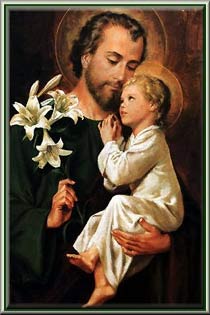 But the promise was fulfilled. St. Joseph may have been a simple carpenter, who did not amount to much during his life, but today he is venerated as one of the greatest saints in the Church. Today we celebrate the Solemnity of St. Joseph, Husband of Mary. There aren’t a lot of Saints for whom we have solemnities. The Church has been observing this feast since the 10th century. And Joseph gets another feast, a Memorial on May 1st: the Feast of St. Joseph, the Worker. St. Joseph is the patron saint of husbands, of fathers, the patron saint of families, the patron saint of homes, the patron saint of workers. He is the unofficial patron against doubt and hesitation, as well as the patron saint of fighting communism, and of a happy death. Joseph is believed to pray also for pregnant women, travelers, immigrants, and people buying or selling houses. In 1870, St. Joseph was declared patron of the universal Church. He is the Patron of the Church! And for us in our country, we should all know that St. Joseph is the principal patron of Canada. That’s a huge responsibility for a man of so few words. But it’s a perfect job for a man of action.
And so, as we journey through Lent – especially when we gather around the Eucharistic table, let’s pray to St. Joseph: Let him guide us and help us open our hearts to God’s plan. That we may be upright and righteous; that we may be men and women after God’s will; that we may be able to pray, “Father show me how I fit into this plan of yours.” And dream. Let God speak to you in your dreams and then get up and do as the angel of the Lord directs you. God has a great plan for everyone. Even for a simple carpenter.
–
Images: Top — Bartolomé Esteban Murillo’s St. Joseph leading the Christ Child. Bottom: St. Joseph devotional card.
First published November 18, 2010
Muslims around the world celebrated Tuesday the feast of Eid al-Adha – commonly known as Eid, which marks the end of Hajj. Hajj is the annual pilgrimage to Mecca, the city in Saudi Arabia, regarded as the holiest site in Islam, since the prophet Muhammad proclaimed Islam in that city in the 7th century.
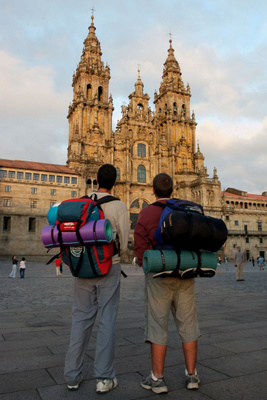 Hajj is the largest annual pilgrimage in the world and considered a religious duty among Muslims, who believe that every able-bodied Muslim who can afford to do so, must make the pilgrimage at least once in their lifetime. Hajj is a demonstration of the solidarity of the Muslim people and their submission to Allah.
Hajj is associated with the life of Muhammad, but some Muslims believe that the pilgrimage to Mecca dates back to the time of Abraham. In a way it makes sense, since pilgrimage is something that has been part of our human nature since the beginning of time.
And pilgrimage is not just associated with religion. A pilgrimage can be any journey to a place that holds significance for us: Graceland, a war memorial, a place from our childhood, a grandparent’s home town… Even here in Canada we have our own version of pilgrimage. It’s called a “road trip.” How often did I sit in the “comfort” of a Greyhound bus for hours (sometimes days) going somewhere and getting “lost and found” in the traveling? All these journeys help us (yes, even Graceland) find, or define ourselves – to a certain extent.
As many of you know, I was recently in the Holy Land. We visited several “places of significance” in Jordan, in Palestine and in Israel. In a way (and I wrote about this) it was good to be meeting with people, “the living stones,” instead of visiting so many religious sites. I guess that’s a personal thing for me: it’s of special significance to me to meet people. Yes, places hold meaning and can transform us, but people, like a mirror, have the ability to reflect us back to ourselves.
Last May, I also traveled to the Yukon for the filming of Ends of the Earth. On the last day, we went on a hike, a pilgrimage really, up Sheep Mt. It was a difficult hike: five hours to climb up to 6000 ft. And somehow, without having any conscious spiritual desire or doing it as a search for anything, nor for any religious reason, it was at the top of Sheep Mt. that I had a profound moment of transformation: A moment of experiencing the divine; one of those moments that shape us forever.
I read the news of Hajj, I think of World Youth Days, where Catholics of every age also gather as a demonstration of solidarity with each other, with the Church and with Christ, and of their submission to God. And it’s important that this demonstration happens in the form of a pilgrimage.
World Youth Day at its best does not include hotel rooms or meals in fancy restaurants (or restaurants at all!). World Youth Day is about sleeping on the floor in a school gym and eating peanut butter sandwiches and apples. It is about not sleeping, or sleeping in the rain at Downsview Park, and sometimes not eating at all. Anyone who’s walked the Camino de Santiago can attest to that!
And so, a pilgrimage is not just a journey to a religious site. We go on pilgrimages to get out of ourselves. I think of Jesus inviting us to “deny ourselves, pick up our cross and follow him (Lk 9:23; Mat 16: 24; Mk 8:34). There is something about picking up our cross that has to do with denying ourselves. Denying ourselves of those things that make us proud and righteous – of those things that make us feel good, comfortable. It is an emptying of sorts that takes place. And who doesn’t need emptying? Emptying ourselves of prejudices, of biases, of expectations, of our pain and brokenness, of our need to be right, of our need to fix things, of our need to control, our need to be God…
And this often happens in the midst of a pilgrimage. It happens inadvertently in the midst of the tightening hamstrings and the blisters. It happens when the backpack straps are digging so hard into our shoulders and we long for nothing more than our own warm bed. It’s funny how that happens.
Which is why a tourist can travel through many places, but a pilgrim lets the places travel through them. A tourist returns home with a heavier suitcase; a pilgrim returns with a lighter load.
And so, as the three million Muslims who traveled to Mecca this year return home, let’s remember that we too are called to solidarity with each other and submission to God. And as some of us continue to prepare for next year’s pilgrimage to Madrid for World Youth Day 2011, let’s remember that while a physical and arduous journey can be helpful, it is not necessary. We can empty ourselves, deny ourselves and pick up our cross daily, and let places transform us and be present and authentic to people, right here at home.
–
CNS photo/Giancarlo Giuliani, Catholic Press Photo
First published September 29, 2010
The census is back in the news with the government potentially voting on keeping or scrapping the mandatory long-form.
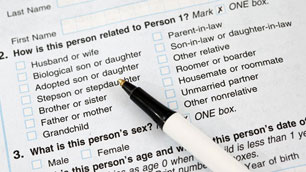 Several years ago (either 1991 or 1995), I was fairly unemployed and Fr. Bert Foliot, SJ, my pastor at the time, hooked me up to work for the Census Canada. All I had to do was go door to door in a particular neighbourhood and help Spanish-speaking people fill out the census form. I must say, it was a very interesting couple of weeks. Now there are some people in Canada who want to scrap the mandatory long-form of the census and I am remembering those days, so long ago.
Let me explain: Most people get a short census form – it collects basic information: age, marital status, ethnic background, religion, number of children, that sort of thing. But every 50 or so households receive a long-form census. This one is more involved with all kinds of questions from property ownership to employment, mobility, child care, housing and income. The issue? Some people feel that some of this information should be private and confidential and that the government has no business asking how many rooms your house has – and if one refuses, it should not be a criminal offence.
The thing is, many organizations, including the Catholic Church, rely on this information in order to provide services. It’s not a campaign to invade people’s privacy or “big brother is watching.” This information is useful.
Here’s my perspective: we expect the state to provide us with various services but then we don’t want to give anything to the state in return. I think that’s silly. From what I remember, most people were happy to fill out the long-form census – they needed help, and sometimes questions would go unanswered, but generally, there were no issues. In fact, I would be happy to fill out a long-form census any time. I don’t believe it’s an infringement on my privacy – I get a lot from the Canadian government and the various organizations that use this data – it’s the least I can do to help them out.
Click here to read the letter sent to Minister of Industry, Tony Clement, on behalf of the Canadian Conference of Catholic Bishops, in support of the mandatory long-form census form.


 deacon pedro