

Lecturas: Lucas 2:1-14 y Mateo 1:1-25
Ya llegó la Navidad y todas esas preocupaciones que tenemos; la comida; los invitados; la familia, los regalos – se multiplican. Pero se supone que Jesús nació para traernos la paz. Pero en este tiempo del año, a veces, lo que menos sentimos es paz.
Y venimos a misa para por lo menos tener un momentito de paz. Esperamos escuchar en el Evangelio esa linda historia de navidad con los ángeles y el cielo estrellado; con los pastorcitos y los corderitos (o nos imaginamos que si hay pastores, debe haber corderitos). Pero en vez de esa linda historia, escuchamos esta larga lista de nombres: ¡Los antepasados de Jesús! Todos esos nombres que no se pueden pronunciar: Jeconías, Zorobabel y Roboam. ¡42 nombres! ¿Qué tiene que ver todo eso con la Navidad?
Bueno, tiene que ver con la paciencia de Dios; con su fidelidad y su plan. Y de eso se trata la Navidad: De la paciencia de Dios, de su fidelidad y de su plan. Es una lectura que nos recuerda que Dios es más grande que todos nosotros y nuestros planes. En los antepasados de Jesús tenemos a todos los héroes y a todos los mafiosos de la historia Hebrea. Tenemos a todos los santos y a todos los pecadores. Comenzando con el más grande, Abraham, el papá de todo el pueblo Judío. Abraham tuvo una fe increíble. Y su hijo Isaac también fue un grande. Pero el hijo de Isaac, Jacob, fue un medio mentiroso y hijo mayor de Jacob, Judá fue el querido hermano a quien se le ocurrió la gran idea de vender a su hermanito José a la esclavitud. El que le sigue a Judá, Fares fue uno que nació porque Judá se acostó con su nuera, Tamar, pensando que era una prostituta. Y así seguimos con unos antepasados no muy perfectos hasta llegar al rey David; el gran rey David; grande y lujurioso que se acuesta con la esposa de Urías (que casualmente era uno de sus amigos y generales) y cuando se entera que está embarazada hace unos arreglos para que Urías muera en el campo de batalla. Pero es uno de los hijos de David con la esposa de Urías que llega a ser el gran rey Salomón, uno de los grandes reyes de Israel. Y de ahí seguimos con todos los mafiosos y desastrosos hijos, nietos y bisnietos de Salomón cuyos pecados llevaron a la división de Israel y Judea y al exilio en Babilonia. Y del exilio, catorce generaciones más tarde nace San José que se casa con esa adolescente que ya estaba embarazada…
Read more…
![Gaetano Gandolfi [Public domain], via Wikimedia Commons](https://deaconpedro.com/wp-content/uploads/2013/12/josephs_dream_painting_by_gaetano_gandolfi_c-_1790.jpg?w=497&h=278)
‘Joseph’s Dream’ by Gaetano Gandolfi, c.1790.
Thinking about Nelson Mandela the last couple of weeks I was reminded of a quote that I always thought was his, from his 1994 inaugural speech. I knew it was from a poem by Marianne Wilkinson, but I thought Mandela had quoted her: “Our greatest fear is not that we are inadequate, but that we are powerful beyond belief.” Turns out Mandela never said those words or quoted Marianne Wilkinson, still, I find those words so inspiring. And I wonder what is it about some words that they have the power to inspire. Recently I read a blog article that spoke about Martin Luther’s famous 1963 “I have a dream” speech and how inspirational it was. I’ve heard a story that Dr. King had a different speech prepared that day. He had already begun that speech when the Gospel singer Mahalia Jackson, who was sitting close by, yelled at him to “tell them about the dream, Martin.” The rest is history. It was an inspirational speech. The blog article explained that Dr. King could have titled his speech, “I have a complaint”, and God knows he had a lot to complain about, but instead he chose to tell us about the dream. Complaints don’t inspire us. Had he done an “I have a complaint” speech no one would have remembered it. But we remember “I have a dream.” And I guess that’s why I am also inspired by the “our greatest fear” poem.
Read more…
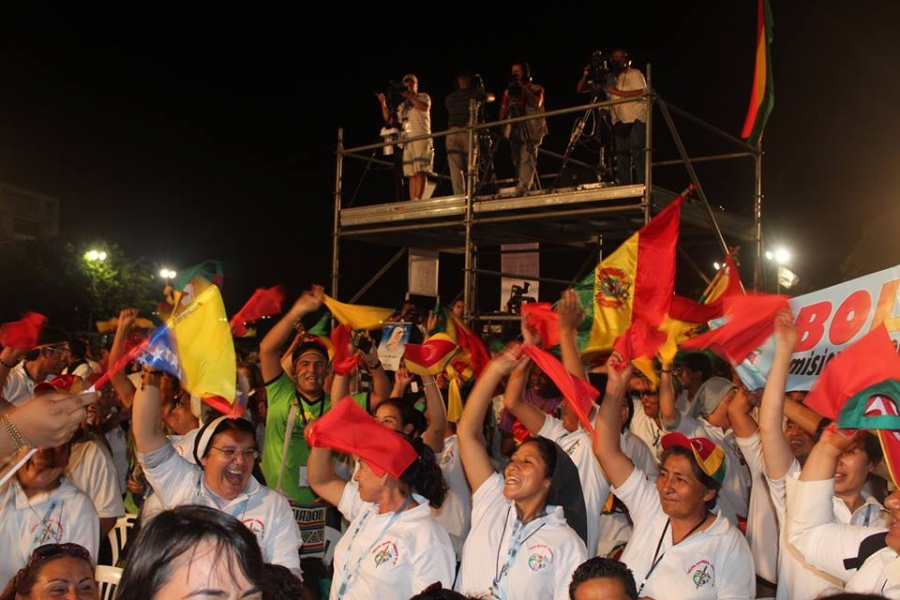
Bolivians celebrate as it is announced that the next Missionary Congress will take place in their country in 2018.
My homily for the second sunday in Advent, Year A. The readings are: Isaiah 11:1-10; Psalm 72; Romans 15:4-9 and Matthew 3:1-12
The voice crying out in the wilderness “prepare the way of the Lord!” I love John the Baptist. He’s my role model. I guess we can say that John the Baptist is the first proclaimer. Maybe we can say that he is the first missionary.
I’ve been thinking about missionaries a lot recently for a number of reasons. The first is that two weeks ago, Pope Francis published his first Apostolic Exhortation. It’s not like an encyclical, or a letter; it’s more like a book! It’s 274 pages! It’s called Evangelii Gaudium: The joy of the Gospel. And he writes about a lot of things, all in the context of the joy of the Gospel and the joy with which we should always share the gospel. In it he writes, “I am a mission on this earth.” (EG 273) That really struck me. It’s more than simply I am called to be a missionary or I have a mission: I AM a mission. And he doesn’t mean that he alone is mission; he means that all of us are mission. We are the mission of the Father: The Church is the mission of God. And who better to say that about than John the Baptist? John was mission. On the day he was born his Father, Zechariah (remember he had lost his voice because he doubted the angel) regained his voice and prays a beautiful canticle (Luke 1:68-79), the Canticle of Zechariah: “You my child shall become the prophet of the most high, for you will go before the Lord to prepare his way; to give his people knowledge of salvation, by the forgiveness of their sins.” From the day he was born, John had a mission and he became that mission: to prepare the way. Even before Jesus himself was proclaiming the Good News, John was proclaiming the Good News.
Read more…
“Since 1981, millions of people, have traveled to a little town on the border of Croatia and Bosnia-Herzegovina because 6 children claim to have visions of Mary, the Mother of God. Are they all crazy?” That’s the question asked by the trailer of The Triumph, a new documentary film by Sean Bloomfield.
In August 1987, my eldest sister gave me a book. It’s titled, Reina de la Paz: Seis Años de Apariciones Marianas en una Aldea Yugoslava (Queen of Peace: Six Years of Marian Apparitions in a Yugoslavian Town). It’s written by Fr. Francisco (Paco) Verar, a Panamanian priest I had got to know when I was much younger. He had gone to the small Yugoslavian town of Medjugorje where reportedly, Mary had been appearing to a group of six children since 1981.
The book begins with a very clear disclaimer note saying that with the book the authors do not pretend to anticipate the Church’s ruling on the apparitions. I guess, at the time, it was not expected that the visionaries would still claim to be having apparitions 30 years later. In fact, in the prologue Fr. Paco writes that when he first heard about Medjugorje he thought, “how is it possible that the Virgin Mary has been appearing daily since 1981!” Needless to say, Fr. Paco went to Medjugorje and, although, already a priest, had a conversion experience. He’s been back many times.
Read more…


 deacon pedro