
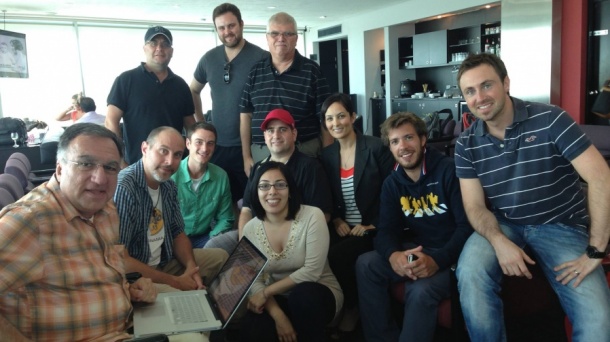
Salt + Light Rio Team. Back row: Wally Tello, David Leross, Javier Capella. Front row: Fr. Thomas Rosica, CSB, Deacon Pedro, Sebastian Gomes, Richard Valenti, Cheridan Sanders, Charles LeBourgeois, Joshua Lanzarini. Front: Alicia Ambrosio.
How fitting: We set off on our journey to Rio on the Feast of St. Bonaventure, literally “bona aventura” or good adventure. That’s what World Youth Day is: An adventure in faith. I wonder if that’s what the disciples were thinking as they made their way down from Galilee to Jerusalem with Jesus for that fateful Passover.
I thought of that last Sunday. For the last couple of weeks we’ve been listening to various readings from the Gospel of Luke. In them, Jesus is teaching the disciples what it means to be a disciple. He tells them it means to pick up your cross; it means to deny yourself. And then he sends them out; first the twelve and then the seventy-two. They go out on a mission to proclaim the Kingdom of God and they do that by healing the sick, caring for the afflicted and expelling evil spirits.
Read more…
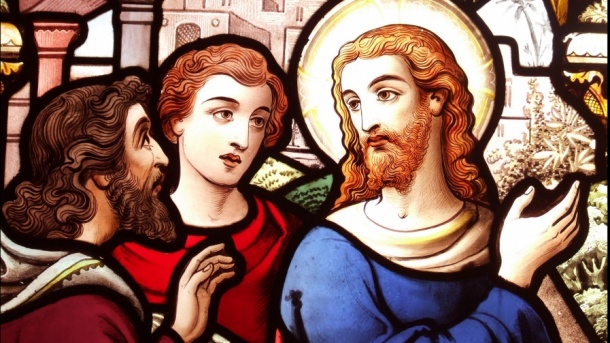
A reflection for the 12th Sunday, Ordinary Time, Year C
Zechariah 12:10-11; Psalm: 63; Galatians 3:26-29; Luke 9:18-24
Whenever I interview someone for a TV or Radio show, often I ask them how they want to be introduced. I am always interested in how they introduce themselves. Of course, most of the time it has to do with the context of the interview so they introduce themselves by what they do: “I’m a professor of theology” or “I’m a Canon Lawyer” or “I’m the Bishop of Whitehorse.” Sometimes it’s who they are, “I’m a priest” or “a Carmelite nun” or where they are from, “I’m a Jesuit from Malta.” I’ve been amazed at people who introduce themselves as parents, “I’m a dad” or “I’m a husband” or “wife.” “I’m a grandparent.” I am a husband, a father of two boys, a deacon, a film and TV producer, I host a TV and a radio program, I work at Salt + Light Media and I am from Panama. I live north of Toronto, I am dog owner and I love pizza.” How you introduce yourself will depend on the context of the conversation or the relationship, but who do you say that you are to yourself? When you are alone, who do you say that you are? When you are alone at prayer, who do you say that you are to God?
Today Jesus asks his disciples, who they say that He is. We’ve all heard this story many times, because it’s in all three synoptic Gospels, Matthew (16:13-20), Mark (8:27-30) and Luke (9:18-24). Jesus asks, “Who do you say that I am,” and Peter answers correctly, “You are the Christ.” But in Luke’s version of the story, Jesus goes straight to the point. There is no praise for Peter, as there is in Matthew, “Blessed are you Simon, son of Jonah… You are Peter and on this rock I will build my Church.” And there is no rebuke of Peter when he refuses to accept the suffering of Jesus as in Matthew and Mark, “get behind me Satan.” Luke goes to the heart of the matter. Jesus doesn’t deny that he’s the Christ (in fact, the term “Son of Man” referred to the Messianic figure) and tells them what it means that He is the Christ, “the Son of Man must suffer, be rejected, be killed and be raised on the third day.” (Lk 9:22) This made no sense to the disciples. This didn’t fit with their idea of Messiah.
Read more…
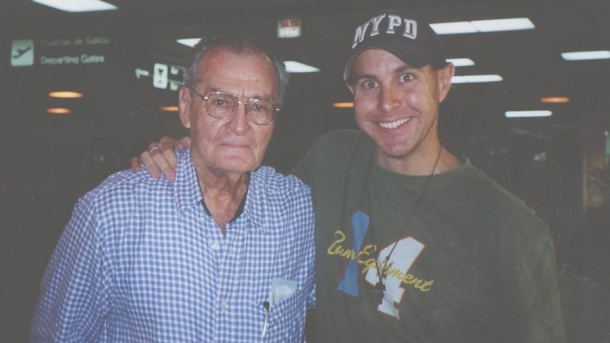
I wrote this in March 2010 as an opening commentary for the SLHOUR. I don’t think I ever published it, but it is as relevant today as it always will be. Happy Father’s Day!
I believe that the most important job I will ever do is be a Dad to my children.
Last week I reluctantly agreed to take my two boys mini-golfing. I had work to do, but I figured this was more important. My youngest son, Daniel was having a hard time with one of the holes and so I stood in a place where his ball would hit my foot and bounce in the hole. Daniel was thrilled.
My older son, Nicolas asked if I had stood there on purpose. I asked him why I would do that and he responded, “Because you are a good father”.
When I was little, I used to have a story about a bunny who everyone asked what he wanted to be when he grew up: A firefighter, a construction worker? No, what the little bunny wanted to be was a daddy bunny. That last image of that story- of a Dad bunny putting his little bunnies to bed is engraved in my mind. I wanted to be that Daddy Bunny. I have always wanted to be a Dad.
But being a Dad is more than just having children. You actually have to bring them up as well. And that’s when it gets tough. In many ways, I believe, in this day and age, the odds are against us parents.
In my dreams I have a fantasy that my boss is requiring me to spend more time in the office and I tell him that I can’t and so I quit, so I can be home with my kids. Thankfully this is just a fantasy. My wife and I have been lucky to have jobs that allow us to spend time at home with our kids.
But spending time with them is not enough. We are also responsible for them. One thing I believe is that ultimately it doesn’t matter whether we say yes or no to our kids. What matters is that we make the decision in a way that will show them that we care about what they think and feel. When they grow up, they won’t remember whether we let them stay out late or not, they’ll remember that we cared about them enough to listen to them and to take the time.
But just loving your kids is not enough. We have to teach them values – but how? I believe values are not taught to kids, values are caught by kids. They learn our values by watching and listening to us – which is why if I am not home, they are not watching and listening to me – they are catching the values of someone else – or from the TV – so I try to be with them as much as possible and to live my life as best I can so they see and learn what kind of man I am. Hopefully, it’s the kind of man that they’ll want to be one day.
I believe that if I spend too much time trying to make money so I can take the kids to Disney World, or move to a bigger house – the time will fly and we’ll never do those things, and before I know it – I didn’t even spend time with them.
I don’t remember caring about not having the things that other kids had – but I do remember playing catch with my dad – I remember him taking us to the little amusement park in town. And I hope those are the things he remembers too – because, at the time of death, it won’t matter how much money I made, or how many projects I completed. It won’t matter how big my house was or whether we went to Disney World or not. What will matter is what kind of Dad I was and what my kids think of me.
What will matter is what kind of men they grow up to be.
If they think of me as a “good Father”, that’s a good life lived.
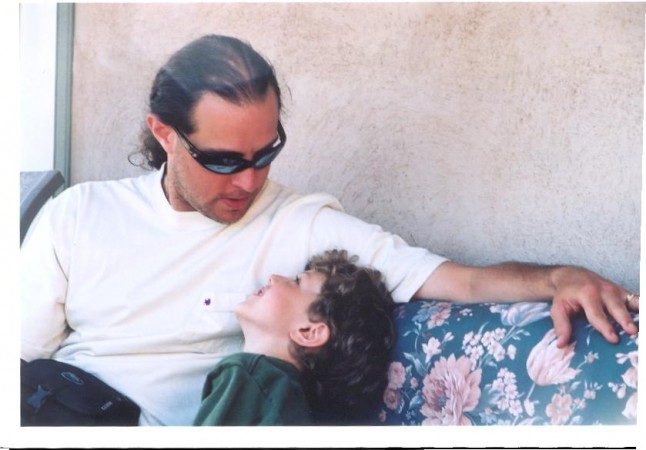
First published on Salt + Light Blog, June 16, 2012
And being a son.
But I’m getting ahead of myself.
My reflection began yesterday, on the Feast of the Sacred Heart of Jesus. I did not grow up with a big devotion to the Sacred Heart, although I was familiar with the image of Jesus looking straight at you, pointing at his heart, which can be visible on the outside of his body. I knew the image, but I never really gave it much thought.
Until yesterday.
It seems silly and obvious, but yesterday, it struck me that the feast of the Sacred Heart of Jesus is all about love. Of course. Heart equals love. Not sure why it hadn’t been obvious before. I just hadn’t thought about it.
I grew up with the notion that the father is the head of the family and the mother is the heart. It seems old-fashioned, but I did grow up in Latin America in the 70’s. The idea of Jesus being the “heart”, while logical, does not really jive with these notions. Jesus is a man. He is the head of the body. Mary is the one with the heart. (And rightfully, today we celebrated the Feast of the Immaculate Heart of Mary.)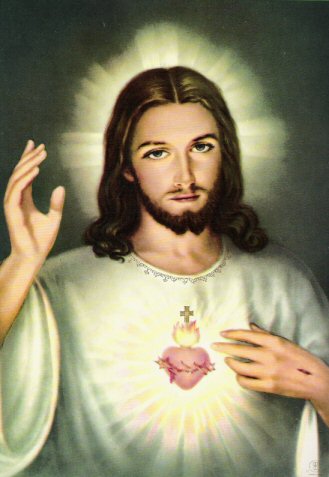
Although now that I am father I see that what makes me a good dad is not much my head, but more my heart. And I want my sons to grow up to be men (and husbands and dads, if that is what they are being called to) who have heart. I don’t mean “heart” as in “the heart of a lion.” I mean “heart” as in “feeling.”
Recently, a Jesuit priest, Fr. Keith Langstaff told me that in the times of Jesus, the ideas of “head” and “heart” were completely the opposite of what we have today. For us, the head is the place of wisdom, of sound logic. Ideas come from the head, the mind. The heart, on the other hand, is where we feel. In the times of Jesus, it was the other way around. The Jewish notion 2000 years ago, was that one thought with the heart and one felt with the head. Completely backwards.
And I’m not entirely sure where I am going with this, except that I like the idea that Jesus is not only head or only heart. I like the idea that being the head of the family doesn’t mean that I can’t have heart. I like the idea that if Jesus has a Sacred Heart, that means that God, the Father, also has a Sacred Heart. God is a God who is head, but also who feels, who loves. God is not a God of the intellect (although He is that), but a God of the senses.
In listening to a program dedicated to fathers yesterday on Focus on the Family, I was amazed to hear that most people, when speaking about their dads, no matter how old they are now, tend to get emotional. There is something about our dad-relationships that makes us emotional. At the end of the program, the host said something that is so true: “We all long for the love of a Father.” It’s no coincidence that God is Father. God is Father and we all long for the love of a Father.
And that is I think, what the Feast of the Sacred Heart is all about. And maybe it’s no coincidence that this great feast is now celebrated so close to Father’s Day.
So, tonight, as I stay awake a bit longer, I pray for all fathers. I pray for your head, but mostly I pray for your heart. I pray that you continually strive to love your children as the Father loves His children. With a love that pours itself out completely, totally and eternally, unselfishly, unconditionally and without restraint.
Happy Father’s Day. And may your hearts too, be sacred.
-


Comments
ambitious4faa4f9763 on God Loves You! Not What We Were | d… on Remember the Eschaton? gloriannaisaza on Remember the Eschaton? Love lifted up: Part… on Love lifted up: Part 3 Love lifted up: Part… on Love lifted up: Part 2


