
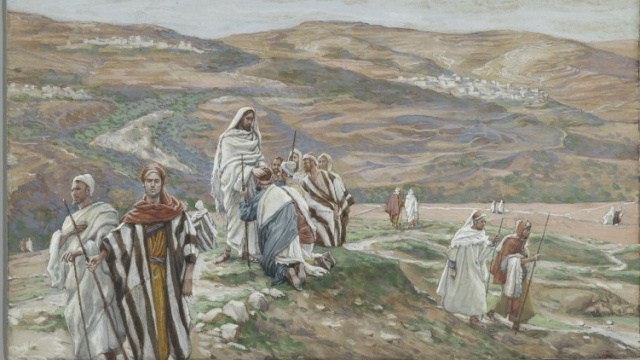
A reflection for the 15th Sunday in Ordinary Time, year B. The readings are Amos 7:12-15; Psalm 85; Ephesians 1:3-14 and Mark 6:7-13.
Today Jesus give us the tools that we need for the mission. So we need to first ask ourselves one question: “What is the mission?” What is our two-fold mission? Our mission is, first, to get to Heaven and second, to take others with us. We don’t go alone; we go together.
If you’re still unsure about that, just re-read the beginning of Paul’s letter to the Ephesians: God chose us to be holy and without blemish before him. And we have already received the first installment of our inheritance, the Holy Spirit. So no excuses. If you had the secret to the cure for cancer, wouldn’t you share that with everyone? Well, we have something better: the secret to life, to abundant life, to eternal life; the secret to eternal joy and satisfaction; the secret to holiness; the secret to getting to Heaven! No excuses like we heard last week with Ezekiel being sent to a rebellious people who didn’t listen to him (Ez 2:2-5). If people don’t listen to you, so what? Proclaim the Good News anyway. If people don’t recognise you, as happened to Jesus that he wasn’t even recognised in his own town (Mark 6:1-6). If people don’t recognise you; proclaim the Good News anyway. And no excuses about being weak, as we heard from Paul (2 Cor 12:7-10). No excuses about being weak, or not being prepared or being a sinner. Proclaim the Good News anyway!
Read more…
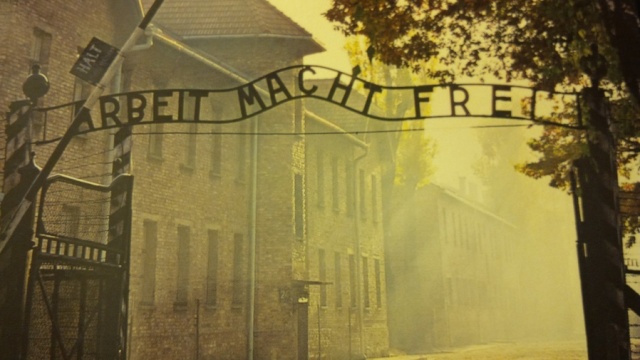
A reflection for the 13th Sunday in Ordinary Time, Year B. The readings are, Wisdom 1:13-15, 2:23-24; Psalm 30; 2 Corinthians 8:7, 9, 13-15 and Mark 5:21-43.
God did not make death. That’s what I kept thinking last Saturday. You see, I was in Poland and last Saturday I had the chance to spend the day at the memorial at the Auschwitz-Birkenau extermination camps. All I kept thinking was, “God did not make death.” But there was a lot of death at Auschwitz.
Between 1940 and 1945, some 1.2 million men, women and children were brought by the Nazis to the extermination camps of Auschwitz and Birkenau in Nazi-occupied Poland. Of these, 90% were killed and of those who were killed, about 90% were Jews. People would be brought to Auschwitz in box train cars (for cattle). When they arrived, they would be forced off the trains and separated by gender: men to one side and women to the other. Then they would be separated again: Those who were deemed suitable for work and those not suitable for work. If you were found not suitable for work, you would be sent directly to the gas chamber. 75% of the people who arrived in Auschwitz never stayed there; they went straight from the train into the gas chamber. Among them, a Jewish woman converted to Catholicism by the name of Edith Stein and her sister Rosa. Edith Stein was a Carmelite Sister and is now known as St. Teresa Benedicta of Cross.
Read more…

A reflection on the Solemnity of the Ascension, cycle B. The readings are Acts 1:1-11, Psalm 47, Ephesians 1:17-23 and Mark 16:15-20.
I was speaking at a high school recently and I did my usual spiel about having one destination (Heaven) and then I say that actually there are two destinations but the second one is not such a great option. I want the kids to know that they have to aim for Heaven. Afterwards, the chaplain, who’s a good friend of mine, said to me, “I know why you tell the kids that they have to aim for Heaven, but for some of these kids that’s so far away. These are kids who are dealing with addiction and abuse issues, with gender issues and the breakup of the family. They need to know how to live right here on earth. And I thought, “That’s exactly why I tell them about Heaven.” Heaven is the anchor that helps us navigate through life.
Catholic singer, Sarah Hart has a great song that says, “any road will do if you have no destination.” Heaven is our destination. Knowing that helps us pick the right road: We keep our eyes on Heaven and our feet planted right here on earth.
And then I thought that this is in part what the Ascension story is about.
Read more…

A reflection for the 4 Sunday of Easter, Cycle B. The readings are Acts 4:8-12, Psalm 118, 1 John 3:1-2 and John 10:11-18.
I don’t own sheep nor do I know the first thing about sheep. But I do own a dog.
Have I told you about our dog? We own a 9-year-old, 85lbs, blond, golden retriever by the name of Max. And Max knows my voice. Max hears my voice. If I say, “Max come,” he comes. If I say, “sit,” he sits. “Lie down,” he lies down. If I say, “Max stay,” he stays… most of the time – at least for a little bit. If some food falls on the floor and I say, “Max leave it!” he leaves it. Max hears my voice very well… when we’re inside the house. If he’s in the yard and I call him, he probably will come, eventually. But if I whistle, he comes right away, because he knows that a whistle means he’s going to get a treat. Our hope is that if he’s ever off running down the street, we can whistle and he’ll come straight home. It hasn’t happened yet. If Max were out in the field or in a forest, it’s likely that, if I call him home, he won’t come – not immediately anyway. Now, if I were to bring Max into Church one Sunday and I called him, I’m pretty sure that he would not come. Not with 300 new people to smell and say hello to. There are just too many distractions that are more interesting than me. See, Max knows my voice; he hears my voice; but he doesn’t always listen.
Read more…


